Showing posts with label MyView. Show all posts

Saturday, May 10, 2025

myView Reflection

It's that time of the year when you think about myView and how the journey went this year. You might also be thinking about what you need to do differently next year to be more successful, after that glorious summer break! 

Here are the slides to get you thinking and celebrating! :) We did a lot and you should be proud! Don't forget to complete the survey so we can hear your view!


Monday, April 7, 2025

MyView Learning Letter #29-Explicit Instruction - How well I teach = How well they learn!


Uffda. That is big responsibility. How well I teach = How well they learn. Sometimes it’s hard to accept that the way we are teaching isn’t working for our students. Don’t feel discouraged if this is the case for you. 

Instead, work on improving how explicit you are with your instruction. Explicit instruction is "systematic method of teaching, proceeding in small steps, checking for student understanding, and achieving active participation by all." It's using the gradual release method of I Do, We Do, You Do. 

Teach first, then ask the questions. Be clear with your instruction. 

Or, work on improving the organization of your lessons to achieve higher levels of engagement. Be intentional with your instruction and don’t be afraid to adjust your approach when needed. Ask your literacy coach for ideas. Check out the engagement page on our website. 

No matter what, don't just stay in the land of students not learning. You have the power to control what you do and the impact of that will be outstanding! We are the adults. If kids aren't learning, we can't blame them. I leave you with this quote...


Thursday, February 20, 2025

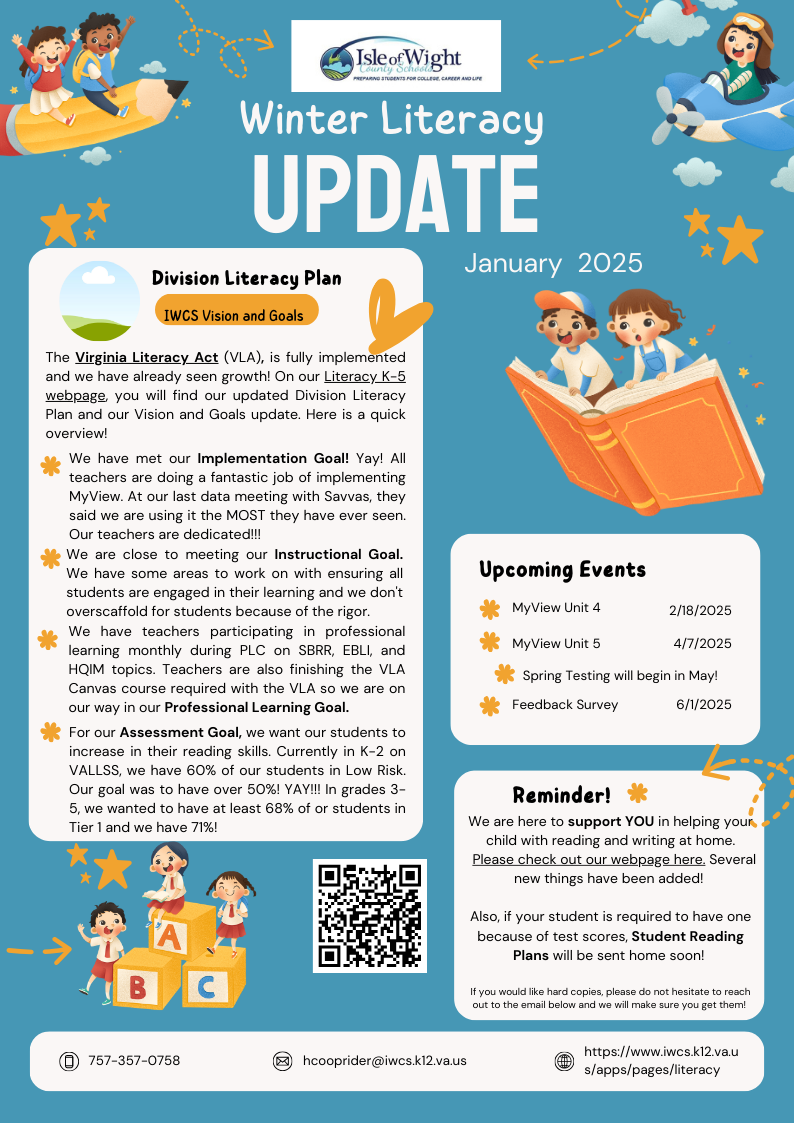
Family Support for Literacy

My family means the world to me and even just typing that is an understatement. I love and value my family first. A close second is the families I serve. Because family is so important to me personally, I am always trying to reflect and think of our student's families. 

It may not look like it or seem like it, but I truly believe our school families are sending us the best student they can. I might be overgeneralizing here, but I feel...

* Most families just don't know how the school system works like we do because we are on the "inside". 

* Most families don't know what they don't know and therefore, don't ask for help because they don't know to. They trust that we will tell them.

* Most families want to help their student, but they don't want to seem silly or stupid by asking. 

* Most families are wore out doing the best they can to provide for their families. 

...and I feel this way because I have been "that family". My child went to a new school system where I didn't know how it worked, didn't know what I didn't know about high school, didn't want to ask because I felt stupid because I do work in a school district, and I was tired working my butt off in the 9 to 5. 

While all that is true, I know better so I did better. I asked the questions and did what I could to help her. This experience taught me that we have to be clear and kind with our families. We have to presume positive intent and give them the resources they would need to be the parent who helps their student succeed. True, some may not use it. However, that doesn't mean we don't for the few, hopefully many, that will. 

That is why I have put together our Literacy Help for Families website. 

https://sites.google.com/iwcs.k12.va.us/literacyhelpcenter/myview

Here are some new things I have added to help our families. Please join me in spreading the word and providing feedback about what else I should add. 

* Handwriting worksheets for manuscript and cursive - For those students really struggling with handwriting, print these and send home for families. Have the student circle their BEST letter! 

* Fluency Progress Graphs and Kid Friendly Fluency Rubric - You could send home the cold read weekly in grades 1-5 in order to help with this. Another idea would be to send home the weekly foldable decodable texts. 

* Writing Rubrics by grade level - You could print one and send them home to each family at the beginning of the unit. Have kids write at home and bring a writing in for extra credit. 


Tuesday, February 18, 2025

MyView Learning Letter #27-Engagement, Again!


One of the biggest complaints I hear about MyView is how boring it is. One of the biggest things I see is the teacher doing more work than the students. In order to solve both of those concerns, the answer is something as simple as engagement. How do we get students to participate more in their learning?

While it is simple, it's not easy. There are LOTS of explicit things you need to teach your students about how to engage in their learning. And sometimes, let's be honest. It's easier for you to just control what is happening and have kids sit there. While that it is easier, it's not better for kids. 

On our new webpage, I have added a video that shows how I would engage students in ALL of the MyView lessons in order to build engagement. I probably need to go back and add some things for the writing section, but you will get the idea. I have also added other resources to help with engagement on this page and I am always seeking feedback so please share what you think is missing! 

Happy Engaging! ;)


Thursday, December 5, 2024

MyView Learning Letter #25 -Scaffolding Instruction

I know we have ALL felt how rigorous our new literacy curriculum is. The end result is going to be AMAZING for our students, but uffda. It's a lot right now in the messy middle. Here is a fantastic blog post from Timothy Shanahan on how to teach above a student's reading level. May it offer you some helpful tips as you scaffold for your students to help them achieve great things! 

In the meantime, let's talk about what scaffolding is. Scaffolding is what teachers do FIRST to help students. 


Scaffolds don't stay forever. They are only there as long as a student needs them and the goal is for them to do things on their own.

Scaffolds also aren't complicated. Here are some quick ways to scaffold for student success. 

1) Model EXACTLY what kids need to do. 

2) Talk about what kids know about the topic BEFORE they learn it. 

3) Provide talk time. HAVE KIDS TURN AND TALK ABOUT WHAT THEY ARE LEARNING. 

4) Pre-teach the vocabulary. Thankfully, MyView does this for us. However, make sure you have images and time to talk about the word. 

5) Create anchor charts WITH the kids, otherwise it is just a poster and won't be as meaningful. 

6) Give kids wait time. Let them think. 


What scaffold are you going to try first? Which ones do you already use? 

Stay tuned for more information and tips on how to scaffold for student success as the year goes on. 

Sunday, November 24, 2024

MyView Learning Letter #24 - Explicit Instruction


Anita Archer is well known for her expertise in explicit instruction. Above is an image of her "Archerisms" and in order to help support the rigor and lack of engagement some are experiencing when teaching reading and writing with MyView, we are going to focus on each "ism" one at a time and do a deep dive. 

The first is quite common and I am sure you have heard it a lot. In fact, it's listed in the MyView Teacher's Edition and we talked about it when using American Reading Company's materials. You might also know it as the gradual release of responsibility. It's I Do, We Do, You Do. This is the heart of explicit teaching. You are clearly telling kids what they are going to learn and how to learn it. 

What I have found that when I am teaching, I think I am doing this in this order. I think I am doing an I Do. But really, I am doing a We Do. It happens more often in teaching that you think. We are in the modeling section or the I Do part of the lesson, but we start asking the kids about how to do "it" instead of explicitly telling or showing them. We jump right into We Do and then send them on their way to You Do. However, they never really saw how to do it or heard the think aloud about how to do in a good I Do. 

In order to make sure the I Do happens the way it's supposed to, you have to be intentional with the planning. You have to actually think about what it is that you, the teacher, are going to show how to do. And a lot of the times, this HAS to involve a think aloud. You have to think and share what you are thinking. The beautiful thing is, MyView has this already listed for you. It's the blue section that has what you should say so that it is explicit. Nothing more, nothing less. 

Here is a graphic to help you be more intentional with the I Do, We Do, You Do so that you are explicit in your teachers so that kids LEARN! :) 


Wednesday, October 9, 2024

MyView Learning Letter #23 - Rigor

Raise your hand if, UFFDA, MyView is rigorous. Yep! I think we are all feeling it. Ok. You can put your hand down. :) 

Here is what I wrote for families: 

Our new curriculum is rigorous. It is thorough when teaching our students foundational reading and writing skills through explicit instruction. Because of the high expectations of what students are learning and doing, students may find it difficult until they get used to it. All that we teach in literacy is from the VA Standards of Learning, These new standards (SOL), which are also rigorous, are taught through our curriculum, MyView. 

Another part of the increased rigor includes the fact that our students are writing all the time! Students write in reading and in writing. They are writing vocabulary and spelling words. While it is wonderful for students to write a lot, writing is one of the most complicated and taxing things for a student to do. The act of writing by hand is a complex skill that goes beyond the simple act of putting pen to paper. It involves a symphony of cognitive, perceptual, and motor skills that intricately work together.

Finally, another reason MyView is so rigorous is the fact that we are asking students to do a lot of thinking! We are teaching children the process of thinking about what they are reading and writing and then being able to communicate that to us through speech and writing.

Here is what I am writing to you, teachers:


Our new curriculum is rigorous. It is laying some serious foundation in ALL the skills in ALL the grades. You might find yourself teaching something that you don't think is valuable for your grade. I would argue that it is valuable because you are building background knowledge that will help students later. An example is suffixes. Suffixes seem like an upper elementary skill, right? Yet, we are teaching -s and -ed in early elementary. (See image below.) 

Yes. It is difficult for students, now. Yes. They can't do it, yet. However, we are going to start with what they DO know and CAN do. Look for other posts about differentiation and scaffolding support to help our students rise to the rigor!


I

Sunday, October 6, 2024

MyView Learning Letter #22 - Missing Conferencing?

One thing that was beloved by all with American Reading Company were the conferences. Conferences were one one one times with a student that were guided by the IRLA assessment to specifically teach what a student needed for reading skills and they afforded a time to listen to each child read aloud to you. 

Well, there are still things in MyView that do just that! 

Online, these resources provide you with a ton of options for kids to read aloud to you AND many provide you with lessons. (The exception is the Games and Digital Practice.) 


Other options include - 

- the Foldable Readables in grades 4 & 5

- the MyFocus Readers (this is like Scholastic News)

- the decodables in the Foundational Skills Toolkit for grades K-2

- MyFocus Intervention Passages 

Sunday, September 22, 2024

MyView Learning Letter #21 - Feedforward


Feedback is information about reactions to a product, a person's performance of a task, etc. which is used as a basis for improvement. Feed forward is Solution-Oriented, Practical, and Actionable. Feed forward helps people envision and focus on creating a positive, future-focused approach to moving ahead rather than concentrating on oversights of the past. We want to hear from you! It is important to name problems. However, there is POWER in naming solutions. Therefore, if there are things that are not working with MyView, please share a solution that can get us moving forward to success. 


Remember, no curriculum will be the SILVER bullet that is perfect. All have some things to improve upon. That's why we need your input! 

Also, there are always things that you may have liked and we are really focused on things you are learning since this is a learning year! Please make sure you share those!!! 

Friday, September 6, 2024

MyView Learning Letter #19-Expectations

As we implement new high quality instructional materials, there are lots of questions about what is ok and what's not ok. We are trying to be clear and kind so we created a document to help. (It can be found on the MyView webpage towards the middle.) We will continue to update it as the year goes. Share your wonders to help us be even more clear and kind!!! 

Lots of learning is taking place this year so remember to give yourself lots of grace while you make those mistakes! It will be ok! Remember, all the walk throughs and feedback are non-evaluative. We want to support you and help you implement the HQIM with confidence! 


Thursday, August 22, 2024

MyView Learning Letter #18-What to do with the "old" stuff?


Great question! What do you do with all the old stuff we used to use in literacy?! Well, let me tell you a story. When we adopted American Reading Company materials, we went ALL IN. We got rid of a LOT of things that we figured wouldn't be needed. What we learned is that we could have used a lot of those things. 

So...I recommend we keep things like word talk, the grammar progression slides, and other resources JUST in case we need them. Remember, we are taking action and using MyView. However, we are going to have to assess how it is going and if it's not going, then we will have to adjust. 


Thursday, July 11, 2024

MyView Learning Letter #17- Savvas & Canvas for Grades 3-5

Savvas has an easy integration with Canvas! All content for grades 3-5 can be pushed through Canvas as the Learning Management System to be used on the Chromebooks. All assessments will be in Canvas. 

If you don't want digital, that's ok! You will have access to print and copy student resources as well. 

Here is a site that gives you more information to prepare. https://sites.google.com/view/savvas-realize-lms-integration/canvas

And of course, more information will be coming in August! :) 


Tuesday, July 2, 2024

MyView Learning Letter #15 - Why HQIM & SOR?

But before why, let's start with what does HQIM and SOR stand for? 
HQIM = high quality instructional materials
SOR = Science of Reading 

Now that we have gotten that out of the way, "Asking all educators to center their daily instruction in the new instructional materials can be a big change. We must build a common understanding of why this change is necessary with classroom educators, school leaders, and community members. Below are some of the key messages that should be shared with stakeholders to build their understanding of, and investment in, HQIM change." from VDOE Implementation Playbook, page 26

Key Message #1:
HQIM adoption supports our vision and helps us achieve our goals. 

Key Message #2:
 HQIM impacts student learning because it is based on science-based reading research (SBRR).

Key Message #3:

HQIM provides consistency and equal opportunities for learning for EVERY student in EVERY classroom. Adopting a single, coherent curriculum across schools will mean that all students are held to the same expectations and effectively experience the adopted Standards of Learning. 


Key Message #4:

By adopting and using HQIM, teachers will have consistent access to high-quality, grade-level content, and they will no longer spend significant time searching for or creating materials for daily lessons. Instead, teachers can use their new materials to focus on the needs of their students and creating instructional experiences grounded in materials and supports tailored to their needs. 


So...throughout this school year, you will about MyView Literacy by Savvas that is built on the Science of Reading (SOR). Read more about SOR here.


Thursday, June 20, 2024

Coffee Chats (In-Person or Virtual)

If you have questions or want to talk about ANYTHING related to literacy, books, the VLA, MyView...you have two options to imbibe and discuss. :) 

1) Come visit me at Cure on the following dates and times. 

July 11 from 9:00-10:30 a.m.

July 15 from 3:00-4:30 p.m.

July 23 from 11:00-12:30 p.m.

2) Jump on a zoom to chat at the following dates and times. 

July 1 from 10:00-11:00 a.m. 

July 18 from 3:00-4:00 p.m. 

July 24 from 8:00-9:00 a.m.


Tuesday, June 18, 2024

MyView Learning Letter #14-Rigor


MyView will be rigorous. Our standards expect it, especially with text complexity and making sure all students have access to grade-level text regardless of reading level. 

Now, we don't want our students to feel like the ones pictured above and that the rigor is so HEAVY they won't feel success. That is why we have to come up beside them and provide scaffolds, like a ladder, to help them do some of the lifting until they are strong enough to do it on their own. That doesn't happen overnight, but it has. to. happen for kids to learn. You can't always be the one doing all the rigorous work. 

Here is how curriculum gets "watered down" and isn't as rigorous, paraphrased by yours truly from this recording on curriculum reform. When I say teachers, I may or may not be talking about you. That is for you to decide. I am just stating the facts I learned from this recording. Trust me, there is no judgement as I type these words because they are just as hard for me to face as well. I have been there, done that, and worked harder than my students too many times to count. 

1) Teachers have a belief that the kids "can't do it". Yep, that is harsh. It starts with you. (Anyone else think of Haim G. Ginott right now?!)

2) Because of this belief, teachers start to shift away from the core instruction that is rigorous and do the cognitive lift, or thinking, for the students. Who has ever filled out a graphic organizer "with" the kids and it wasn't the direct instruction time? You would totally see my hand raised! 

3) Over time, this keeps happening and teachers keep simplifying the tasks which lowers the grade level and rigor to where what is being taught isn't aligned to the standards anymore. 

4) The results? Students do not perform well on tests. 

I know this is not what any of us wants. So, over the course of the year, we will learn about those scaffolds and how we can support our students with the heavy lifting and thinking until they can do it on their own. 


Friday, June 14, 2024

MyView Learning Letter #13- Teacher Autonomy


One of the many concerns teachers have about adopting a new curriculum is that they feel they will lose their autonomy in what is taught and will become "robots" teaching from a scripted curriculum. How do I know? Because I am that teacher. I fought Reading First and having to use that basal so hard because "my way" was better. Well, I was young and I have learned. Maya Angelou said it best, 

“Do the best you can until you know better. Then when you know better, do better.”

Boy have I felt this in my bones. Here's what I have learned and will continue to learn: 

1) Autonomy means the quality or state of being self-governing. While there will be a systematic and explicit pacing to follow, which you already do, you are still in charge of what that looks like in your classroom. You will have govern what the lesson looks like in your classroom based on the students in your care. More about this in #5. https://www.edweek.org/leadership/teacher-autonomy-isnt-dead-heres-how-to-achieve-it/2023/09

2)  I was not explicit in my teaching and sometimes am still not! I learned this after a coaching round at Westside this year. Following a scripted curriculum helps me be explicit which is how kids learn best.  https://www.understood.org/en/articles/what-is-explicit-instruction

3) "HQIM (high quality instructional materials) Does Not Mean a Loss of Teacher Autonomy". This was taken from the VDOE's VLA Implementation Playbook  on page 25. "Many teachers fear a loss of autonomy when new curriculum is introduced. These fears are understandable for HQIM does require teachers to use their materials to ground all of their daily instructional experiences. That said, teachers will now be able to focus on how to engage their students in that content in the daily HQIM. As teachers become more versed with the daily lesson plans within the HQIM, teachers should be encouraged to think deeply about how to ensure students not only engage fully in that learning, but that students own the learning within the daily lesson." Having a plethora of the quality instructional materials means you get to focus on the delivery (internalizing and adapting) of the lessons rather than creating them. There is no planning and thinking about what to do, you get to plan the HOW. 

4) This section is taken from UFLI Foundation's Teacher's Manual about Implementation Guidance. "Implementation fidelity refers to the degree to which a program is implemented as designed. If the program is not implemented as designed, it may not achieve the intended student outcomes." (page 35) 

When I read this, I think back to countless of situations where we are not getting the student results we have wanted and many times, the company will say, "Well, you haven't been using it the way it was designed." Oh. You're right. 

Here is another quote from UFLI. "Attaining implementation fidelity should not mean that your lessons are stilted or robotic. Quite the contrary! As noted throughout this handbook, brisk lesson pacing and high student engagement are essential elements of every lesson. The key is keeping the lesson fun and supportive of students' needs. The best way to ensure student success is providing as many opportunities to respond as you possibly can during the lesson. Varying those practice opportunities keeps it interesting for studnets but varying it too much can take up valuable instructional time as you explain each new activity. It is fine to put your own stamp on the lesson, to personalize it to fit your teacher style as long as you accomplish the lesson goals." (page 36)

5) In The Broken Logic of "Sold a Story": A Personal Response to "The Science of Reading" by Thomas Newkirk found here (second link), section 11 says it best! "Science and Being Scientific I recently came across a comment from a parent, I've lost the source, but the gist was: even though the Science of Reading programs restricted teacher decision-making, they were firmly based on science. And according to the parent, that was a good trade off. Publishers are lining up with scripted, paced, structured, explicit programs that are advertised as based on the science of reading. There is a paradox here: "science" is viewed as a set of established truths that teachers implement, without being scientific themselves. That is, without the expectation that they monitor the results of their own teaching, and adjust that teaching based on what they see. In these systems they are not acting, or allowed to act, with the agency Tolstoy advocated: "the best method would be the one which would answer best to the difficulties incurred by the pupil, that is not a method but an art and talent." The problem here is that science is viewed as coercive, and producing results so certain, so conclusive that the only ethical position for practitioners is to accept and implement these truths. The issue, we are told, has been settled, the question of best practice answered. Yet the very nature of science is to be unsettled, to restlessly challenge received wisdom, and to constantly test out conventional wisdom in the cauldron of our own experience and professional work." (page 25) 

You must be scientific and not just teach the lesson scripted without paying attention to your own teaching and how the students are learning. You will need to look at the students in your class and figure out how to scaffold the lesson to make sure your students learn it. I go back to what the authors in UFLI said, personalize it to fit you and your studnets AS LONG AS YOU ACCOMPLISH THE LESSON GOALS. 

I know these 5 notes will not change your thinking immediately. I do hope that they have caused you to pause and reflect. That's the start. :) 

If you have strong feelings and beliefs about this topic, please reach out! I would love to chat because I have them, too! 


Tuesday, June 11, 2024

MyView Learning Letter #12-HQIM


As we begin to use MyView's high quality instructional materials, let's remember to stay KALM. Here is what we are going to Keep and Add. Here is what we are going to do Less or More of. 

    1. Keep

      1. UFLI, Heggerty

      2. STAR 2-5

    2. Add

      1. VALLSS replaces PALS

      2. Skill based assessments from MyView

      3. Lexia (optional) K-5

        1. will be used by intervention 

    3. Less 

      1. School Pace Leveling 

      2. Conferencing 

      3. Freckle 

      4. Waterford 

    4. More 

      1. MyView Materials
    1. Waiting - We will wait and hold on to these resources because we are not sure how they can be used, yet.

      1. The Writing Revolution, Grammar Progression, SIM Strategy, Word Talk

Sunday, June 9, 2024

MyView Learning Letter #10-Small Group


While there will be no more readers conferences, that format will help you because your small groups will be flexible based on data. The data you will use to make decisions about instruction will be based on VALLSS, STAR Reading, and other MyView Assessments.

Small Groups do not mean Guided Reading either. The groups will be fluid based on data so that students get exactly what they need instructionally. Throughout the year, you will learn more about small groups and how they will be build around systematic, explicit instruction and incorporate lots of student practice followed by progress monitoring to ensure the instruction is working!

In the meantime, MyView provides a lot of options for small group. We will learn more about these resources and plan for small group with reading coaches and SpEd Inclusion teachers during weekly planning sessions.

* The TE (Teacher's Edition) has small group lessons that will support core instruction for students who need extra for the week's skills. Think of this as differentiation for core instruction for all students.

* The My Intervention Book also supports core instruction and is grouped by skill. Think of this as a tier 1 or 2 intervention.

* The Reading Routines Book has lessons to remediate specific Foundational Reading skills such as phonics, fluency, and vocabulary. Think of this as a tier 2 or 3 intervention.


Beyond MyView, there are two resources we can use to supplement small group instruction.

* UFLI Foundations