Friday, October 7, 2022

Why teach grammar?

This kept coming up in my Twitter feed...
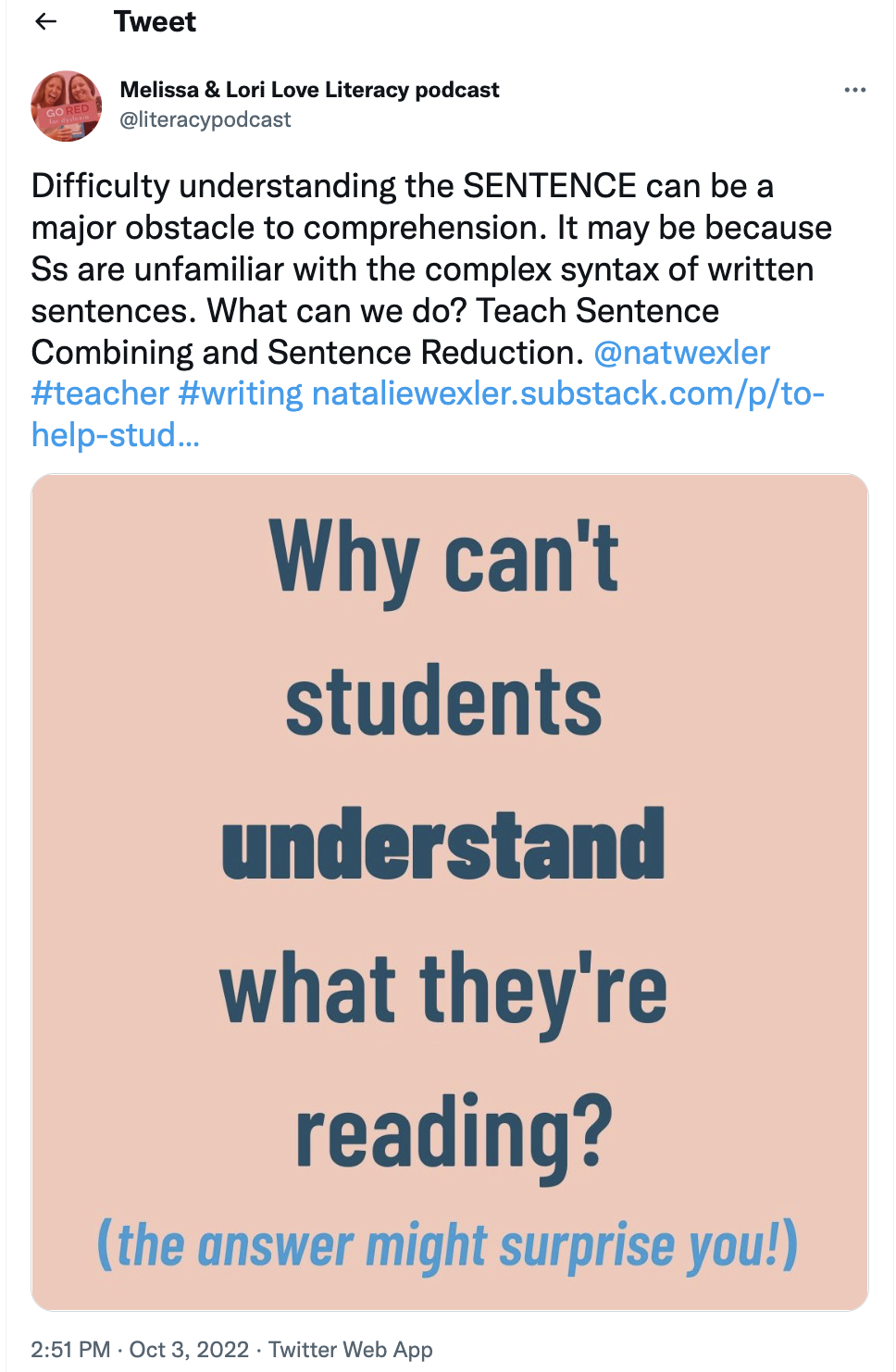


Interested? Read more here.


And this one. 

Saturday, October 1, 2022

Dyslexia Awareness Month-October 2022


While there are MANY sources of information on Dyslexia, here are 3 resources I highly recommend checking out. 


1) Dyslexia in the Classroom: What Every Teacher Needs to Know (International Dyslexia Association)


2) 9 Films that Feature Dyslexia 


3) Our #isleREAD#isleWRITE website! 


Also, please attend our SEAC-Special Education Advisory Committee meeting on Wednesday, October 19th from 6:00-7:00 p.m. at Westside. I will be sharing information with families and the community. Please help spread the word! 


Happy Learning! :) 

Friday, September 16, 2022

Valley of Latent Potential

You all are doing the very hard work of teaching our learners all about school! 

Please keep fighting the good fight of teaching your students those routines and habits for literally everything (decoding, tying shoes, going to the bathroom, lining up for recess, adding, comprehension, identify context clues, etc., etc., etc.) 

Those routines take time. It is really hard to teach them. It is not simple, nor do we want an easy, fast fix. Right now, you are experiencing the valley of latent potential because it is SO difficult right now to keep teaching those routines when students aren't learning them as quickly as you would like. However, when the routine has been learned over time, the actual result will be even better than what you expected!!!! 


​You got this and I got you! ​Please don't give up. Our most vulnerable learners need YOU! :) 

Wednesday, August 31, 2022

Book Talk Tuesday: isleREAD Book Recommendations

Need a new book to read for fun?

Have a book you think others would love to read? 


Check out and add to the #isleREAD Book Recommendations Padlet!!! 


Thursday, August 4, 2022

Anchor Charts

My favorite definition of an anchor chart comes from this Learning for Justice. "An anchor chart is an artifact of classroom learning. Like an anchor, it holds students' and teachers' thoughts, ideas and processes in place. Anchor charts can be displayed as reminders of prior learning and built upon over multiple lessons." 


Anchor charts are a fun, visual reminder for the students who, quite frankly, haven't learned what you are teaching yet. They are a scaffold to support a student who needs the reminder of what you are teaching. In fact, it's one of my favorite teaching tools to display around the room. 

Want to learn more about the BEST way to use them in your classroom for EVERYTHING?? Check out this post by We Are Teachers. Since this is a post about favorites I guess, my favorite line is, "It’s very important not to create the entire poster ahead of time. They are best used as an interactive tool." When created with the kids, they view it as their own and will actually use it rather than that grammar poster you bought and displayed. No offense. They are just not my favorite. ;) 


Thursday, July 14, 2022

Both/And

Some folks think in terms of black and white. There is not gray in their world. I have always appreciated the finite thinking of, "It is this or it is this. There is no in between." My world has ALWAYS seen both sides of the coin. My world has ALWAYS seen gray. My world has always though, "It could be this or this. So much in between." I am not an either/or girl. 


Because of this, my heart and mind struggle immensely against all the controversy in reading currently.  It is not balanced literacy OR science of reading. It is not word walls OR sound walls. It is not kids should only read leveled texts OR kids should never read leveled texts. To be honest, these are just a few of things that are not either/or for me. I could have kept going forever....

My both/and thinking really roared it's head when I listened to this podcast, "A Little Bit of Myth Busting: The Pet Peeves of Reading Experts" by Literacy Talks. 


How about you? Are you either/or or both/and? 


Friday, June 17, 2022

Reflection is a MUST!

Congratulations! You have just finished another hard year in education. While you may NOT want to think about school at all (I truly get it; avoidance can be amazing), I urge you to pause. And reflect. Reflect means to think deeply or carefully about something. You care deeply about teaching, otherwise you wouldn't be in this profession. So...before you completely block out the year ask yourself these questions. 

What do I want to keep doing next year because it worked?

What do I want to stop doing next year because it didn't work? 

What do I want to start doing next year because you have always wanted to do it?

What do I want to change next year because it didn't quit work but it has potential? 


I actually reflect on these questions throughout the year as well. I have a running list titled "Next Year". But you gotta start somewhere. Please pause. Today is a great day to start. 

Happy reflecting! :) 

Friday, June 10, 2022

Did you know there are 44 phonemes in the English language?

The answer is most likely, nope! And, you may not even know what a phoneme is. Guess what? That is a-ok. You weren't really taught what a phoneme was in your undergrad unless you have a speech and language degree. 


A phoneme is the smallest unit of sound heard by our ears. We associate phonemes or sounds with letters. Wanna know something else? Those letters that spell the phonemes are actually called graphemes. Here is an example. The short /i/ phoneme can be spelled with the grapheme i as in pig. The long /I/ phoneme can be spelled with the graphemes i, igh, ie, and then of course iCe like in the words hi, light, pie, and nice. 

Students need to know all 44 phoneme sounds and their corresponding graphemes in order to spell and read. Here is a great 2-pager that lists the most common phonemes and their corresponding graphemes. How many did you know? How many do your students know? 


Happy Learning! 

Friday, October 29, 2021

The Backwards Bike of Change

Change is ___. So many people have written about change. I am not going to write about change and how important it is, how hard it is, or even what it is. I am a planner who struggles a whole HECK of a lot with change. I like it at the end, but I can be a bear during, lashing out my frustration and overwhelm. As someone who truly does have a love-hate relationship with change, let me share my top 3 ways to help me deal with it. 

1) Acceptance. 
Heraclitus, a Greek philosopher, has been quoted as saying “change is the only constant in life.” I have tried so hard to take this quote and refer to it every time I am in the midst of a change and think WHY?!  When I reflect on this, it's true. Nothing is every truly constant or routine. There are always changes, even if they are minor. 


2) Growth. 
I like to watch videos like this to remind myself how frustrating change can be and that's ok. I maybe have the knowledge, but not necessarily the understanding. It takes practice. I also like to know that when I change, no matter how much I like it, I am growing and learning. Even though changing is harder because I have gotten older, I will get it eventually. 


3) Why. 
When I get overwhelmed with the current change flood, I remind myself why I do what I do. I find that this centers me and puts me back on the path of being uncomfortable. I change and grow so that I can be better for those I serve, teachers and students. 


May this encourage you as we journey through change in the field of education like we have never seen, heard of, or experienced. And if you are a teacher of children, we have seen, heard, and experienced a lot! 

Friday, October 1, 2021

Dyslexia Awareness Month-October

One of my ALL time favorite quotes is from Maya Angelou. 


On a deep level, I feel it applies to ALL things, even Dyslexia Awareness Month. Think about it. How many things do you think you know about dyslexia that you believe are facts? Honestly, many of them are misconceptions, and HUGE ones at that! We have to know more about dyslexia so that we can do better for our students. Here are a few resources to help you be more informed and thus do better. 


1) 31 Days of Literacy Learning on Twitter

As a research-based organization committed to improving literacy skills for all learners, AIM is looking forward to sharing information and research in the science of reading from a variety of voices throughout LD Awareness Month and Dyslexia Awareness Month. Our 31 Days of Literacy Learning tweets will feature quotes from literacy experts and researchers supporting literacy. Follow along on Twitter @aimtolearn for quotes from our research partners, AIM faculty and others in the literacy community.

2) Check out some of the resources on this one pager. Just click the image.


3) Join our Dyslexia Learning Crew Google Classroom. 


Let me know how else I can support you in your quest of knowledge! 

Friday, December 4, 2020

Gordon's Ladder of Competency

When you are learning something new, you are quite aware of the change that is occurring. In fact, this awareness has even been studied and can be used a mental model to acknowledge how much we think we know and how much we actually know. To learn more about the learning journey, check out the short, curated list of videos and articles. 


YouTube Videos

Understanding the Learning Journey

The 4 Stages of Learning Anything

Articles 

The Conscious Competence Ladder -Mindtools

Four Stages of Competence -toolshero


Tuesday, September 29, 2020

5 Stages of Grief with Change

Change. Sometimes it feels like a cuss word. One we don't want to admit we are afraid of or use often. Then there is the Heraclitus, Greek philosopher of the late 6th century BCE, quote often quoted, "The only constant is change." In our world, right now, I truly couldn't agree more. Our world in education has changed immensely. 

So how do we really deal with change in a healthy way? I am going to attempt to simplify the process. By going up and down the stages of grief1 as if they were stair steps, acknowledging along the way where you are and seeking the support to work through it, trying to get to the top landing where the change rests. Before you can even take your first step on the stairs, what change resting on the landing is causing you the most grief?  Teaching virtually? Using Canvas? Taking attendance? You must narrow down, as much as possible, to the ONE change that is the most stressful. Now...the steps on those stairs.  

Denial-At the denial stage, you might think and feel that there there is absolutely no need for change. You've got it and it works. 

Anger-In this stage, you are just plain ol' mad you have to change. Period. 

Bargaining-While in this stage, you are thinking that you'll change, but only until it changes again because there is a new program, or new principal, or we'll be back in the building, or the pendulum will swing back around. 

Depression-This stage leads to feeling sad about the change because it meant you had to give up something you've invested in, whether it be time, effort or resources. 

Acceptance-The final stage is where you accept the change and actually celebrate it! 


After reading the 5 stages, I want you to SOAK it in. Appreciate each stage for what it is and leave no room for shame associated with any of the stages. Take it a step further and really SOAK2. This was a strategy I learned while quarantined in March after feeling ALL the feels. Read more about it here from Stephanie Affinito. 

1) Stop where are you, right now in this present moment. Stop and reflect. 

2) Own what stage you are feeling while grieving. Acknowledge the stage. Remember, shame has no home here.

3) Ask what is the most loving thing you can do for yourself? Maybe it's find someone you trust who will listen to you tell them all about the stage of grief you are in. Maybe it's find someone who can help you connect what you invested in to connect with the change. Maybe it is throwing eggs at a tree outside to release some anger. Only you know what will help you. 

4) Keep going. Do the thing for yourself and keep going. Don't give up. People love you and are ready to support you. Your students need it. 


1 Gregory PhD, Christina. "The Five Stages of Grief." PSYCOM. https://www.psycom.net/depression.central.grief.html

2 Affinito, Stephanie. "Try the SOAK Method." The Coaching Sketching Notebook. May 18, 2020 https://stephanieaffinito.blogspot.com/2020/05/try-soak-method.html